Live voyeur streaming is a form of continuous or near-continuous online broadcasting where viewers watch consenting adults in real living spaces.
Unlike many other types of adult live content, the camera is not necessarily the center of attention. Participants know it is there, but they continue with their daily lives while viewers mainly decide where and when to watch.
Human curiosity about others’ lives existed long before the internet. One of the best-known early examples was JenniCam, launched by Jennifer Ringley in 1996. Her project regularly showed parts of her daily life online and became an early example of continuous personal broadcasting.
Today, the format is much more developed. A modern platform may include many locations, several cameras in each home, different viewing angles and 24/7 real-life streaming. VHTV is one example of how this idea has grown into a large online environment where viewers can follow people and events over time.
What Is Live Voyeur Streaming?
Overall, the format is usually built around permanent broadcasts rather than short individual sessions. A location may have cameras in several rooms, giving viewers a choice of where to watch.
Nowadays, consensual voyeur streaming is totally different from hidden-camera recording. Participants know the cameras are installed and agree to appear on the stream.
So many things happen throughout the day. Participants may cook, work, sleep, talk with friends, spend time with partners, invite guests, have parties, argue, make up, have sex or simply do nothing particularly unusual.
That “regular”, casual time is a very important part of the concept.
Instead of just opening a stream for one specific, “perfect” scene, users can return to the same home over days, weeks or years. They begin to recognize the people, their routines and the relationships between them.
Common Live Voyeur Streaming Formats
There simply isn’t a single setup used by every live voyeur platform. The format changes depending on the number of participants, the location and the way cameras are organized.
Bounty or Twix? Single or Couple Streams
Some streams are just built around one participant or a couple.
The audience follows their routines and whatever happens naturally during the day. A simple, quiet evening, a card game or an unexpected guest is just as much a part of the stream as hotter moments.
Shared-House Streaming
Other locations include several people living together or spending a lot of time in the same home.
Friends, partners and guests can also appear. Seeing participants’ social interactions and habits creates a special bond and gives viewers more situations to follow, especially when the same people return regularly or even become participants themselves.
Multi-Camera 24/7 Streaming
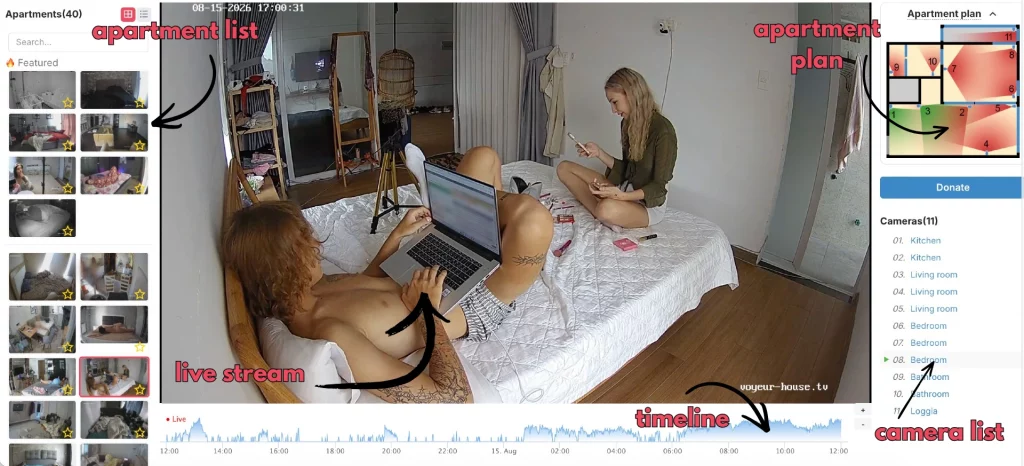
Big projects usually use several cameras in bedrooms, living rooms, kitchens, etc. No place is usually left uncovered unless it’s a toilet or another private area.
Instead of getting one fixed broadcast like on a webcam site, viewers can choose a room or camera themselves and switch between feeds.
Several things may be happening in the same location at the same time. Someone might be cooking in the kitchen while somebody else is chilling in bed or talking with guests somewhere else.
The most important part is that the user decides which part of which location they want to follow.
Live and Recorded Hybrid Formats
Some platforms also keep selected footage from earlier streams.
Live video will always be the main part of the voyeur experience, but as nobody can watch dozens of locations on all cameras 24/7, recorded footage is a great opportunity to return to a particular event later.
How Does Live Voyeur Streaming Work?
From a user’s perspective, you just open a camera and that’s it. Behind it, the stream passes through several stages.
Cameras and other streaming equipment are installed all around a participant location. Each camera has its own video feed.
The footage is sent using the internet connection at that location. Then the platform receives it, processes it and delivers the stream to users through the video player via small chunks operated by a playlist.
The stream is usually transferred in smaller segments that are loaded continuously. This feature allows playback to continue without treating a 24/7 broadcast as one enormous video file.
Any ISP problem, blackout or equipment lag at the location can interrupt the feed instantly. If the camera stops sending footage, there is nothing for the platform to reconstruct later.
The Role of Participants and Viewers
Participants are consenting adults who live or spend time in homes equipped with cameras. They know people are watching, but the stream continues while they go through their normal routines.
Viewers watch remotely. They can choose a location, room or camera, but they usually do not decide what the participant will do next.
Of course, people do not instantly forget that cameras exist.
Someone who has recently joined a project may initially be more aware of the cameras or behave differently around them. That is normal. Any public broadcast changes the environment to some degree.
Over time, however, the camera can become a familiar part of the space. Long periods of normal life, conversations and spontaneous situations begin to matter more than performing something specifically for the audience.
Live Voyeur Cams vs Traditional Webcam Sites
The easiest way to understand voyeur cams vs webcam sites is to look at the role of the viewer.
Traditional webcam platforms are generally based on interaction with a performer. Live voyeur platforms are centered much more on watching an environment and the people inside it.
The terms voyeur webcam and webcam voyeur are sometimes used for both, which can make the distinction confusing. In practice, the viewing experience can be quite different.
| Feature | Live voyeur cams | Traditional webcam sites |
|---|---|---|
| Main focus | Usual real life | Staged session |
| Viewer interaction | Just watching | Chats, tips, requests and private interaction |
| Continuity | 24/7 or close to that | Based on models availability |
| Viewer control | Choice of stream and camera | Requests for action and conversation |
| Typical payment model | Subscription + extra | Tokens |
They may talk to the audience, answer messages, react to tips or change what they are doing in response to requests.
With live voyeur cams, the camera stays in the living environment for much longer periods. Participants do not need to address it constantly.
You may just open a room and see a conversation already in progress, someone just sleeping, a family having dinner or a party that started long before you arrived.
That lack of a fixed session is one of the major differences.
Viewer Interaction and Control
Interaction between viewers and performers plays a much larger role on most traditional webcam platforms.
There, you can chat, send tips, make requests or even pay directly for a private session. The model and the viewer can communicate directly.
As a rule, in live voyeur streaming, you will not see that at all. You cannot influence what’s happening. You are there to observe.
There can still be overlap between the two formats.
Some participants in real-life voyeur projects also work as webcam performers. A viewer may therefore see the same person in two very different settings: daily life through continuous voyeur cameras and a more direct, performance-focused webcam session elsewhere.
The person can be the same while the format remains different.
Continuity
Webcam sessions have a natural start and finish. A performer goes online, runs the session and eventually leaves.
Live voyeur streaming does not need that structure.
A location may stay online throughout the day and night, including the parts where very little is happening. The audience can leave, return hours later and find the same household continuing its day.
Pricing and Choice
Payment models are also usually different.
Most webcam projects commonly use tokens and tips, accept requests and offer private sessions. Spending is often connected to a particular interaction.
Voyeur platforms are more often based on access. For example, a subscription may unlock a larger selection of live feeds or additional viewing features, depending on the service.
The better choice depends on what someone wants to watch.
A user looking for direct communication may prefer traditional webcam sites. Someone more interested in following people, households and spontaneous situations over time may prefer live voyeur streaming.
Live Voyeur Streams vs Recorded Videos
Another common comparison is live voyeur vs recorded videos.
The obvious difference is timing, but that changes more than simply whether the video is live or old.
A live stream is still unfolding. Nobody watching knows exactly what will happen five minutes later.
Recorded footage already has a past. The event is finished, and the viewer can usually pause it, skip parts or replay something immediately.
This is also the basic live stream vs recorded video distinction.
| Feature | Live voyeur streams | Recorded videos |
|---|---|---|
| Timing | Only available in real-time | Can be watched anytime |
| Selection and editing | Raw stream, no editing | Selection of the best moments |
| Interaction with the event | No interaction | No interaction |
| Availability | For online viewers only | Available anytime |
| Main advantage | Non-predictable and feeling there | Can be watched anytime, more action |
Live video has uncertainty built into it.
Sometimes something interesting happens immediately. Sometimes nothing happens for a while. The viewer is watching without knowing which situation will develop.
Recorded content removes most of that uncertainty.
Someone has already identified a piece of footage worth keeping, and viewers can open it whenever they want.
Editing and Selection
A live stream does not normally come with a planned beginning, climax and ending.
It simply continues.
A conversation can start before a viewer opens the camera. A party can last for hours. An interesting moment may happen suddenly between long stretches of normal daily activity.
Recorded footage is different because a specific section has already been selected.
This makes it easier to browse when the viewer wants a particular event, but it also removes part of the unpredictability that comes with live viewing.
Interaction
With recorded footage, the original event is already over.
A viewer can pause the video, rewind it or skip forward, but none of those actions can affect what happened during the recording.
A live stream is still connected to the current moment. If the platform offers any interactive features, they can only matter while the event is taking place.
Even then, direct interaction is not what defines live voyeur streaming. Watching remains the central part of the format.
Viewer Experience and Availability
The biggest advantage of recorded content is convenience.
Nobody can watch every location and every camera all day. People sleep, work, go out or simply choose another feed at the wrong moment.
Recorded videos make selected events available afterward.
Live streams offer something different: the viewer is present before the outcome is known.
For many people, that uncertainty is exactly why live viewing feels different from opening a video that has already been selected and saved.
Why Continuity Matters in Live Voyeur Streaming
Live voyeur streaming is not built around isolated scenes. What happens at one moment often makes more sense when it is connected to everything that came before.
Regular viewers gradually become familiar with the people in a location. They recognize couples, friends and recurring guests, notice routines and understand how different relationships develop over time.
That background adds context. A short conversation or an ordinary interaction may seem insignificant on its own, but it can feel very different to someone who has followed the same household for days or weeks.
For many viewers, this is a major part of the appeal. They are not simply watching separate adult scenes, but following people, relationships and everyday situations as they change.
In that sense, 24/7 real-life streaming has something in common with reality television. The main difference is that there are no fixed episodes or predetermined storylines. Life continues whether something dramatic is happening or not.
FAQ
What is live voyeur streaming?
Live voyeur streaming is continuous or near-continuous online video where viewers watch consenting adults in real living environments. Depending on the platform, viewers can switch between different locations, rooms or camera angles.
Are participants aware of the cameras?
Yes. On consensual live voyeur platforms, adult participants know the cameras are there and agree to appear on the stream.
What is the difference between live voyeur streams and recorded videos?
Live voyeur streams are watched while events are still happening, so the viewer does not know what will happen next. Recorded videos show footage from events that have already taken place and are available to watch later.
Is live voyeur streaming always available 24/7?
Unfortunately, no. Due to external circumstances or personal reasons, a stream may be interrupted from time to time.